Be the first to review “Chicken hearts 300g, pasture raised, low histamine, soya-free, GM-free” Cancel reply

- Free delivery in Milton Keynes, courier mainland UK £10
- food@naturewayfarm.co.uk
- 01908 314556
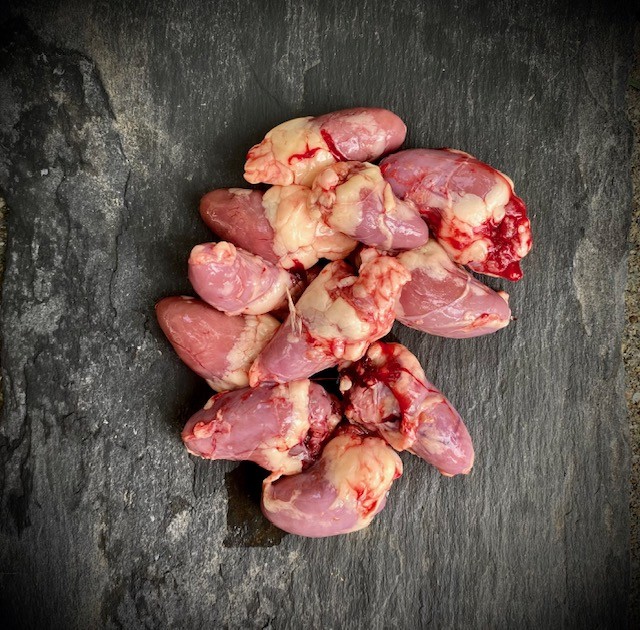
Our pasture-raised chicken hearts are a nutrient-dense, flavourful cut prized by health-conscious cooks. Raised on fresh pasture and moved daily to new ground, our chickens enjoy a natural environment where they can forage, scratch, and thrive.
Fed a GM-free, soya-free diet and reared without routine medications, these chicken hearts are a clean, wholesome source of nutrition. We ensure they are also low in histamine by freezing them within 48hrs of slaughter, making them an excellent choice for those seeking foods suitable for sensitive or low-histamine diets.
Chicken hearts are rich in high-quality protein, iron, zinc, selenium and vitamin B12, helping to support energy production, immune function, and overall wellbeing. As a working muscle, they also contain CoQ10, a naturally occurring compound involved in cellular energy production.
With a rich, meaty flavour and tender texture when cooked correctly, chicken hearts are delicious grilled, pan-fried, skewered on the BBQ, or slow-cooked in stews and broths – why not add to a soup or broth made with our chicken carcass.
£3.90
WILL BE DELIVERED mainly Wednesdays, but can be also Tuesday or Thursday.
The cut-off time for the same week deliveries is:
Orders received from Thursday to Sunday will be delivered the following week.
is Milton Keynes and surrounding areas, plus Towcester, Potterspury and Yardley Gobion.
every Thursday and Saturday
If you are not fully satisfied with the taste of our meat, we will refund you in full.

Our meat is not all labelled organic but it conforms to all the standards and goes well beyond them.
All our cattle and sheep are fed only grass. Grass that is never fertilized or sprayed with herbicides. Even an organic system does not require 100% grass fed system. The beef you get in the shop has been fed a mountain of grain which has been grown with pesticides and fertrilizers.
The herd of grazing animals stimulates grassland to pump CO2 from the air into the soil. Yes, I mean CO2, the greenhouse gas that causes global warming. They do this by intensive grazing for 1 day only and allowing land to recover. After being grazed and re-growing, grassland pumps CO2 into the soil and stores it there as soil carbon while growing taller each time.
One person emits 10 tonnes of CO2 every year. This nearly equals what one of our cows takes from the air and stores in the soil (9.6 tonnes CO2) every year. This is a net CO2 after we have taken away corresponding methane emissions of our herd.
As a calf, it is fed 100 kg of feed in a creep feeder:
60 kg barley
14 kg soya
23.5 kg sugar beet
growing steer (for 100 days) ratio:
350 kg barley
30 kg rapeseed
finishing steer (for 80 days)
600 kg barley
TOTAL feed per steer:
1010 kg barley
30 kg rapeseed
14 kg soya
23.5 kg sugar beet
Source: AHDB
Pesticide figure based on yearly application of pesticides on barley in 2018 (based on application to 0.17 ha that would produce 1 tonne of barley):
spring and winter barley were mixed in equal ratio for simplicity.
Pesticides in spring barley:
157.5 g
Pesticides in winter barley:
307.5 g
TOTAL 465 g of pesticides = to litres it is about 465 ml of pesticides per year.
Source: Pesticides usage survey 284 for arable crops in the United Kingdom 2018 (National Statistics)
Fertilizer figure (based on application to 0.17 ha that would produce 1 tonne of barley):
nitrogen: 24.14 kg
phosphate: 4.59 kg
potash: 5.95 kg
sulfur: 5.95 kg
TOTAL 40.63 kg of fertilizers
Source: British survey of fertilizer practice for 2018 (DEFRA)
At a sequestering rate of 2.5 t C/ha/year2, our herd of 150 cattle can sequester whopping 1,404 t CO2 from the air in the soil. That is equivalent to lifestyle emissions of 140 people.
You can follow my calculations for more details:
This means that a beef cow from such herd sequesters -9.3 t CO2 every year. This is nearly equivalent to yearly emissions of your lifestyle (+10 t CO2/year).
References:
(1)
Teague WR. FORAGES AND PASTURES SYMPOSIUM: COVER CROPS IN LIVESTOCK PRODUCTION: WHOLE-SYSTEM APPROACH: Managing grazing to restore soil health and farm livelihoods1. Journal of Animal Science. February 2018:1519-1530. doi:10.1093/jas/skx060
(2)
Audsley E. An assessment of greenhouse gas emissions from the UK food system and the scope for reduction by 2050: how low can we go. Godalming, UK: WWF UK and Food Climate Research Network. 2010.
Reviews
There are no reviews yet.